awk Isn’t a One-Liner for Cutting Columns
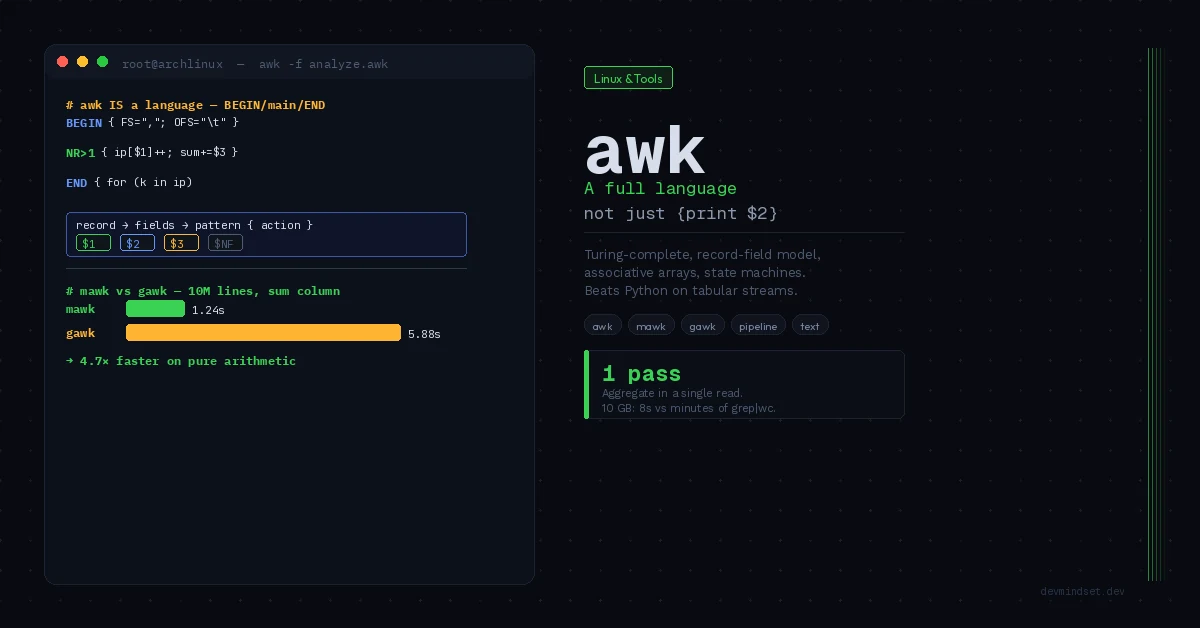
Most developers know awk in one form: awk '{print $2}' to extract the second column. That’s like knowing Python solely through print(). awk is a complete, Turing-complete programming language with its own execution model, types, associative arrays, functions, and control flow — designed specifically for processing text streams, where it beats Python by an order of magnitude in throughput.
The name comes from its creators’ surnames (Aho, Weinberger, Kernighan, 1977) — the same Aho and Kernighan whose signatures sit on the foundations of computer science. awk isn’t a relic; it’s a precise tool that, on a 10 GB log stream, will process the data before Python’s interpreter finishes importing pandas.
This article dissects awk as a language: the record-field model, BEGIN/END blocks, associative arrays, state machines, and — crucial for production decisions — when mawk beats gawk fivefold and when to reach for awk over Python at all.
The Execution Model: Record, Field, Pattern-Action
The foundation of awk is a processing cycle that most users run unconsciously. awk reads input record by record (by default, line = record), splits each record into fields (by default on whitespace), and for each record checks a set of pattern → action rules.
# awk program structure: a series of pattern { action } rules
pattern1 { action1 }
pattern2 { action2 }

# If pattern matches the current record → execute the action
# No pattern → action runs for every record
# No action → defaults to { print $0 } (the whole record)
Built-in variables define each record’s context:
| Variable | Meaning |
|---|---|
$0 | The entire current record |
$1, $2, ... $NF | Individual fields (from 1, not 0) |
NF | Number of Fields — field count in the record |
NR | Number of Records — current record number (global) |
FNR | Record number in the current file (resets between files) |
FS | Field Separator — field delimiter (default whitespace) |
OFS | Output Field Separator — delimiter for print |
RS | Record Separator — record delimiter (default newline) |
BEGIN and END Blocks
Two special patterns turn awk from a filter into a full program. BEGIN runs once before the first record, END once after the last. This enables state initialization and result aggregation:
# Sum and average of the third column — a full program, not a one-liner
BEGIN {
    FS = ","           # separator: comma (CSV)
    OFS = "\t"         # output: tab
    print "Processing..."
}

# Main loop — runs for every record
NR > 1 {              # skip the header (record 1)
    sum += $3
    count++
}

# Runs once, after processing everything
END {
    if (count > 0)
        printf "Sum: %.2f | Average: %.2f | Records: %d\n", \
               sum, sum / count, count
}
Associative Arrays — Where awk Shows Its Claws
Arrays in awk are always associative (hash maps) — indexed by any string, not just a number. This makes awk a natural tool for grouping, counting, and deduplication without any external data structures.
# Counting IP occurrences in an Apache log — a classic production problem
# Input: standard access.log (IP in the first field)

{
    ip_count[$1]++       # array indexed by IP address
}

END {
    # Iterate over the associative array's keys
    for (ip in ip_count) {
        print ip_count[ip], ip
    }
}

# Usage with top-10 sorting:
# awk -f count_ips.awk access.log | sort -rn | head -10
This 6-line program replaces the typical cut | sort | uniq -c | sort -rn pipeline and is significantly faster, because it does everything in a single pass instead of repeatedly sorting the entire stream. For a 5 GB file, the difference is minutes.
Order-Preserving Deduplication
A problem sort -u won’t solve, because it destroys order. awk does it trivially:
# Remove duplicates, preserve first-occurrence order
# (sort -u would change the order — that's a different result)

!seen[$0]++

# Mechanics: seen[$0] is 0 (false) on first occurrence,
# !0 = true → line printed. Post-increment makes it >0,
# so !seen[$0] = false on subsequent ones → line skipped.
This is idiomatic awk: one line, zero external dependencies, single pass. The expression !seen[$0]++ is a pattern with no action — the default action { print $0 } runs only when the pattern is true.
awk as a State Machine
Here awk crosses the line from “text tool” to full language. Range patterns (/start/,/end/) and state variables allow parsing structured formats — sections, blocks, nesting.
# Section parser in a configuration file (INI format)
# Extract all keys from a specific [database] section

BEGIN { in_section = 0 }

# Detect a section header
/^\[.*\]$/ {
    # Strip brackets, compare section name
    section = substr($0, 2, length($0) - 2)
    in_section = (section == "database") ? 1 : 0
    next        # move to the next record
}

# Inside the target section and the line is key=value
in_section && /=/ {
    split($0, kv, "=")
    gsub(/^[ \t]+|[ \t]+$/, "", kv[1])   # trim the key
    gsub(/^[ \t]+|[ \t]+$/, "", kv[2])   # trim the value
    config[kv[1]] = kv[2]
}

END {
    for (key in config)
        printf "%-20s = %s\n", key, config[key]
}
This is a complete state machine: it tracks which section it’s in (in_section), reacts differently based on state, builds a result structure. Writing this in Python would take 3× more code and run slower on large files.
User-Defined Functions
awk supports custom functions with recursion and local scope — further proof it’s a full language:
# Recursive function: factorial (proof of Turing completeness)
function factorial(n) {
    return (n <= 1) ? 1 : n * factorial(n - 1)
}

# Function with local parameters (convention: extra params = locals)
function trim(str,    result) {     # 'result' is a local variable
    result = str
    gsub(/^[ \t\r\n]+|[ \t\r\n]+$/, "", result)
    return result
}

BEGIN {
    print factorial(10)              # 3628800
    print "[" trim("  hello  ") "]"  # [hello]
}
Note the convention: awk has no explicit local variables. The idiom is extra function parameters (indented for readability) — they’re initialized to the empty string and act as locals. This is the only way to avoid polluting the global scope.
mawk vs gawk vs busybox awk — Measurement, Not Ideology
Several awk implementations exist with fundamentally different performance characteristics. The choice has real production consequences.
| Implementation | Characteristics | Throughput (relative) |
|---|---|---|
| mawk | Minimalist, compiles to bytecode, fastest | ★★★★★ (baseline) |
| gawk (GNU) | Richest: extensions, Unicode, networking, debugger | ★★★ (~2–5× slower) |
| busybox awk | Built into embedded systems, minimal | ★★ (variable) |
| goawk | Go implementation, good on CSV, portable | ★★★ (comparable to gawk) |
# Benchmark on a real file — 10M lines, summing a column
$ time mawk '{s+=$1} END{print s}' bignum.txt
real    0m1.243s

$ time gawk '{s+=$1} END{print s}' bignum.txt
real    0m5.876s     # ~4.7× slower on pure arithmetic

# Check which implementation you have by default
$ ls -l $(which awk)
lrwxrwxrwx ... /usr/bin/awk -> mawk      # Debian/Ubuntu often mawk
# or -> gawk on most other distributions
Practical rule: mawk for simple, bulk processing (summing, filtering, counting on gigabyte streams), gawk when you need Unicode, multidimensional arrays, gensub(), built-in sorting (asort), or other GNU extensions. On Debian the default awk is often mawk — which means scripts using gawk extensions will silently fail.
awk vs Python — When to Use Which
| Scenario | Choice |
|---|---|
| Filtering/summing columns on a >1 GB stream | awk (mawk) — single pass, minimal overhead |
A shell pipeline (part of cmd | awk | cmd) | awk — native citizen of the Unix pipeline |
| Simple aggregation/grouping in a single pass | awk — associative arrays for free |
| Logic >50 lines, multiple data structures | Python — readability, testability |
| Parsing JSON/XML/nested formats | Python — awk has no native parser |
| Integration with APIs, databases, external libraries | Python — the ecosystem |
| A one-off transformation in the terminal | awk — zero boilerplate, zero imports |
| Production code requiring unit tests | Python — awk is hard to test |
The line is clear: awk wins on tabular streams in a pipeline, where throughput and brevity matter. Python wins when logic grows, nested structures appear, or the code must live long and be maintained. Reaching for Python to do print $2 is over-engineering; writing a JSON parser in awk is engineering masochism.
Practical Example: Log Analysis in a Single Pass
# Full access.log analysis: status codes, top IPs, total transfer
# One pass through the file, many aggregations simultaneously

BEGIN {
    OFS = "\t"
}

{
    # Field 9 = HTTP status, field 1 = IP, field 10 = bytes
    status[$9]++
    ip_hits[$1]++
    total_bytes += ($10 ~ /^[0-9]+$/) ? $10 : 0

    if ($9 >= 500) errors_5xx++
    if ($9 >= 400 && $9 < 500) errors_4xx++
}

END {
    print "=== Status Codes ==="
    for (code in status)
        print code, status[code]

    print "\n=== Transfer ==="
    printf "Total: %.2f MB\n", total_bytes / 1024 / 1024
    printf "4xx: %d | 5xx: %d\n", errors_4xx, errors_5xx

    print "\n=== Records processed ==="
    print NR
}
This program does in a single pass what would require several separate grep | wc pipelines. On a 10 GB file that’s the difference between 8 seconds and several minutes — because the disk is read once, not five times.
Conclusion: awk as a Precise Tool, Not a Relic
awk isn’t a relic from the 70s nor “a worse Python for text.” It’s a specialized language that, in its domain — tabular streams in a Unix pipeline — beats general-purpose tools by an order of magnitude in throughput and brevity. An engineer who knows awk as a language, not as {print $2}, solves a whole class of problems in one line where others write a script.
The key understandings: the record-field model with its processing cycle, BEGIN/END blocks for state and aggregation, associative arrays for grouping without external structures, and the awareness that mawk and gawk are different tools with different performance. This knowledge turns awk from a black box for cutting columns into a full-fledged engineering tool.
Next time you instinctively reach for Python to process a huge CSV in a pipeline — weigh whether awk would do it five times faster in a tenth of the code.
Potential internal links
.bashrc — anatomy of shell startup and optimization— awk as part of the Unix workflowReading other people's code — navigating without rabbit holes— awk for quick analysis of unknown logsDebugging — how developers actually do it— awk as a tool for analyzing diagnostic streams